 By
By The Independent National Electoral Commission (INEC) has declared results from Saturday’s Area Council elections in the Federal Capital Territory (FCT) and by-elections in Rivers and Kano states, with the All Progressives Congress (APC) recording dominant victories across most contests.
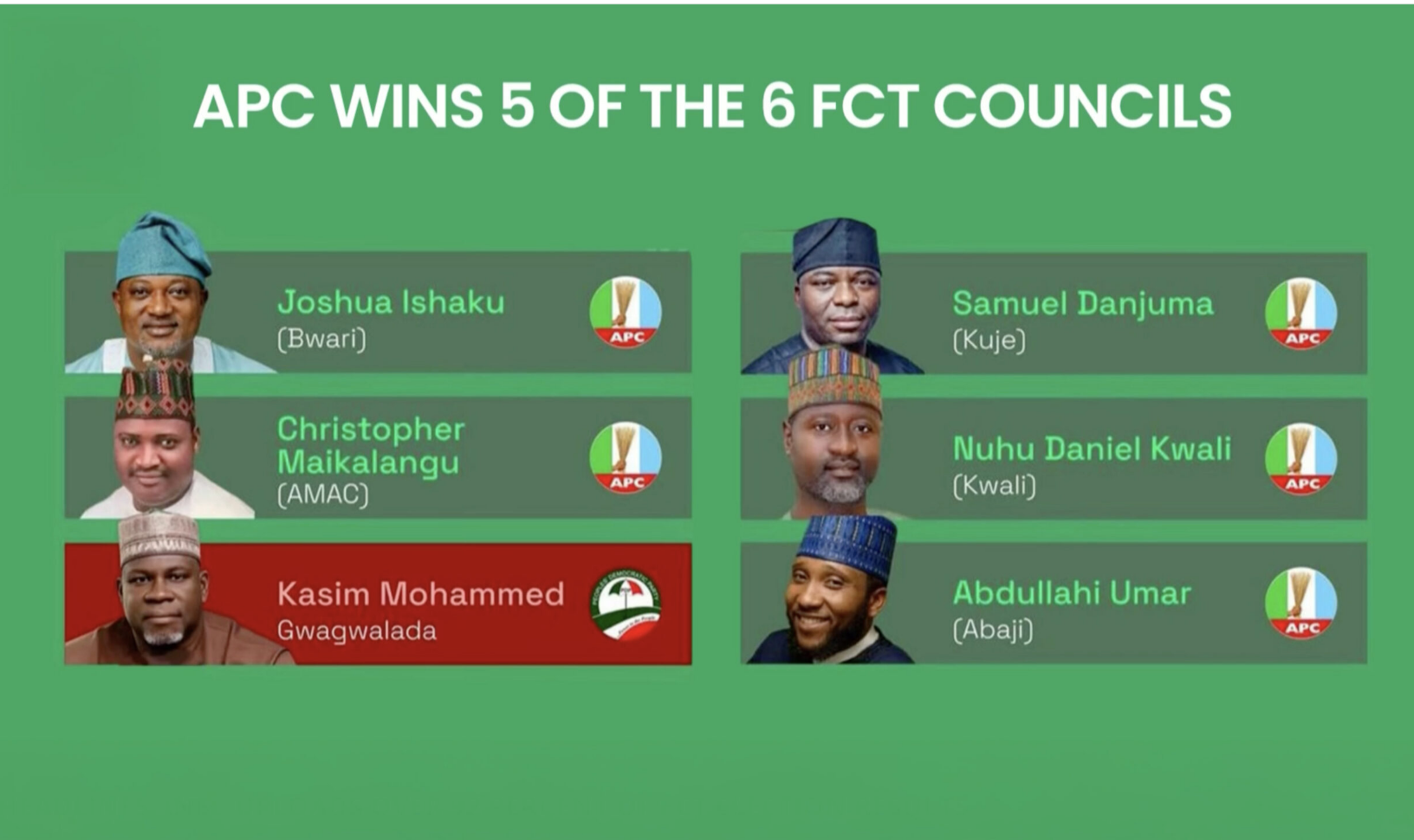
In Kuje Area Council, APC candidate Danjuma Shekwolo emerged winner of the chairmanship election with 17,269 votes. The Returning Officer, Nkiruka Odoh of the University of Abuja, declared him duly elected, having secured the highest number of votes and met all legal requirements.
The Peoples Democratic Party (PDP) candidate, Zakwoyi Danlami, polled 15,824 votes, while Abdullahi Galadima of the All Progressives Grand Alliance (APGA) garnered 4,305 votes.
In Abuja Municipal Area Council (AMAC), APC’s Christopher Maikalangu was re-elected after securing 40,295 votes out of 62,861 valid votes cast. The African Democratic Congress (ADC) polled 12,109 votes, while the PDP recorded 3,398 votes.
Similarly, in Kwali Area Council, APC’s Daniel Nuhu won with 17,032 votes, defeating PDP’s Haruna Pai, who secured 8,575 votes.
However, the PDP recorded a major victory in Gwagwalada Area Council, where its candidate, Mohammed Kasim, won the chairmanship seat with 22,165 votes, defeating APC’s Yahaya Shehu, who polled 17,788 votes. INEC described the election in the area as peaceful and orderly.
APC Dominates Rivers By-Elections
In Rivers State, the APC extended its winning streak in the by-elections. The party’s candidate, Henrietta Loolo, won the Khana Constituency II seat in the State House of Assembly with 7,647 votes, defeating candidates from other parties.
The by-election was conducted to fill the vacancy created by the death of former lawmaker, Dinebari Loolo. Khana Constituency II comprises 155 polling units across eight wards.
Also, APC’s Napoleon Ukalikpe was declared winner of the Ahoada East II Constituency by-election with 3,980 votes. The seat became vacant following the resignation of Edison Ehie, who was appointed Chief of Staff to the state governor.
The by-elections filled two vacant seats in the Rivers State 10th Assembly.
APC Clinches Kano Seats
In Kano State, the APC secured victories in both the Ungogo and Kano Municipal State Assembly by-elections, amid reports of low voter turnout.
In Kano Municipal Constituency, APC candidate Aliyu Daneji polled 7,484 votes to win the seat. The Returning Officer, Ibrahim Siraj, declared him duly elected, having met all constitutional requirements.
Similarly, in Ungogo Constituency, APC’s Aminu Sa’ad won with 8,975 votes. The result was announced by the Returning Officer, Ali Abdullahi.
Notably, major opposition parties, including the PDP, the New Nigeria Peoples Party (NNPP), and the ADC, were absent from the ballot and did not participate in the Kano by-elections.
INEC conducted elections across the six area councils of the FCT for both chairmanship and councillorship positions. By-elections were also held in Ahoada East II and Khana II constituencies in Rivers State, as well as legislative elections in Kano Municipal and Ungogo constituencies in Kano State.
Ahead of the FCT polls, concerns were raised over a disagreement between FCT Minister Nyesom Wike and FCT Senator Ireti Kingibe regarding movement restrictions. Kingibe criticised the 22-hour restriction on movement as excessive and undemocratic, while Wike maintained that the directive had the approval of President Bola Tinubu and was not imposed unilaterally.
Meanwhile, President Tinubu congratulated the winners of the elections in the FCT, Rivers, and Kano states, urging them to govern with humility, patriotism, and a strong commitment to public service.
In a statement issued by his Special Adviser on Information and Strategy, Bayo Onanuga, the President commended INEC, security agencies, and voters for the peaceful conduct of the elections, noting that the exercise further strengthens Nigeria’s democratic process.