 By
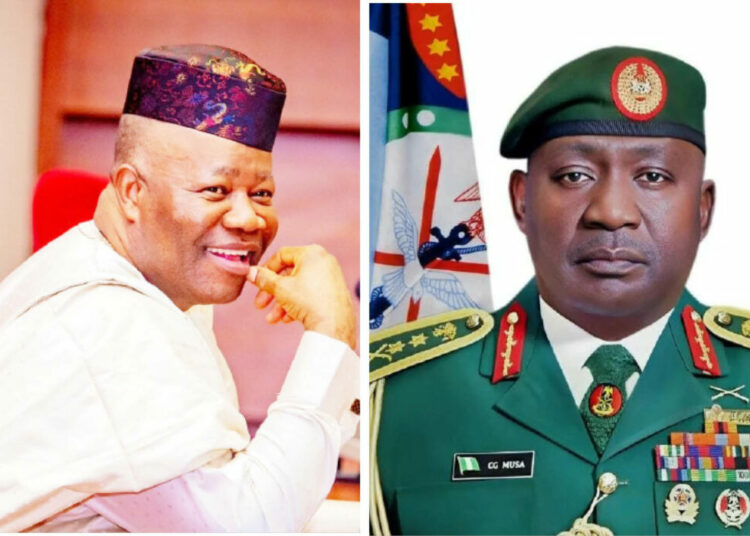
By Nigeria’s newly confirmed Minister of Defence, General Christopher Musa (retd.), has declared that the Federal Government will no longer engage in negotiations or ransom payments to terrorists, kidnappers, or bandits. According to him, such deals only empower criminal networks and escalate insecurity nationwide.
Musa made the statement on Wednesday during his Senate confirmation hearing, where he faced hours of rigorous questioning before lawmakers unanimously approved his appointment. He replaces Mohammed Badaru, who resigned on health grounds.
Akpabio: “Even Donald Trump Is Watching Nigeria’s Security Situation”
The screening session became heated when some lawmakers proposed that the nominee should “take a bow and go,” citing his previous screening as Chief of Defence Staff in 2023.
But Senate President Godswill Akpabio rejected the move, insisting that Nigerians deserved transparent answers about the security situation.
“This is not the time for bow and go. Our constituents want to hear from him. Even Donald Trump is on our neck,” Akpabio said.
The chamber briefly became rowdy before calm was restored and the screening continued.
Musa: ‘Never Negotiate With Criminals’
When asked about strategies to curb mass abductions, Musa took a firm stance:
“There should be no negotiation with criminals. If you pay ransom, they will use the money to buy more weapons. They never abide by any agreement.”
He also dismissed claims that terrorism is targeted at specific religions or regions.
“We are all victims. Those committing these crimes are evil people. They kill indiscriminately. Nigerians must not be allowed to die needlessly.”
‘Military Solution Only 20–25%’
General Musa warned that the armed forces cannot solve insecurity alone.
According to him, security challenges require a comprehensive, inter-agency and community-driven approach that includes state governments, ministries, and local authorities.
He emphasised the need for:
- A unified national security database
- Faster response systems for kidnapping incidents
- Technology-driven intelligence
- Perimeter fencing and improved safety measures in schools
- Strict accountability in defence spending
“Whatever funds are provided must be utilised properly. We must ensure that everything we procure truly supports our armed forces,” he said.
Senate Opens Probe Into Safe School Initiative
Meanwhile, the Senate has launched a major investigation into the Safe School Initiative (SSI). This follows the recent abduction of 25 female students in Kebbi State, where attackers also killed a school administrator.
The 18-member ad-hoc committee, chaired by Senator Orji Uzor Kalu, will audit all funds invested in the programme since its launch in 2014.
Senator Kalu expressed outrage that over 1,680 schoolchildren have been kidnapped and 180 educational facilities attacked in the last decade despite billions of naira and millions of dollars invested in school security.
“We will trace every naira and every dollar allocated to the Safe School Initiative. Nigerians deserve answers,” Kalu said at the committee’s inaugural sitting.
The investigation will review:
- Allocation and utilisation of SSI funds
- Deployment and efficiency of security personnel
- Status of school infrastructure upgrades
- Early warning and emergency response systems
- Partnerships with donors and private-sector contributors
The committee has four weeks to present its report.
Background: Billions Spent, Schools Still Unsafe
The Safe School Initiative was launched in 2014 following the Chibok schoolgirls abduction, with initial funding of $10 million and additional funding of over $30 million from 2014 to 2021. The Federal Government also earmarked ₦144 billion for school safety under the 2023–2026 budget cycle.
Yet, attacks on schools continue to rise, prompting renewed scrutiny of the programme’s implementation.
What Comes Next
General Musa’s confirmation marks a major shift at the Ministry of Defence at a time of rising student kidnappings and widespread insecurity across the country. His strong position against negotiating with terrorists and his call for community-driven policing signal a new direction for national security.
As the Senate begins its probe into the Safe School Initiative, Nigerians will be watching closely to see whether the government can deliver real accountability and lasting reforms.